
Weather is such a fascinating topic once you start getting into the nitty gritty of it all. There are so many different types of weather, so many different ways the Earth can impact everything around you. I’m no expert on weather, or meteorology, but I know a few people who are, and I know how to do my research into it. So, I thought, as part of my Sunday School science lessons, that I’d do my best to explain different weather phenomena.
So, for the first of these weather lessons, we’re going to be looking into my favourite of them all…
Lightning storms
A Lightning storm, also known as a thunderstorm, is a common weather phenomenon all over the world. Statistically, on average lightning strikes the Earth over 40 times a second, meaning that in the time it’s taken you to read this sentence, nearly 200 lightning strikes have occurred somewhere on the Earth.
Lightning is the massive electrical discharge of clouds, literally meaning that the clouds have too much electrical charge within them and are desperately trying to get rid of it. The lightning between the two regions passes enormous amounts of energy, completely ionising the air around it. If lightning strikes infrastructure, it can often cause a lot of damage, blackouts, and completely fry electronics.
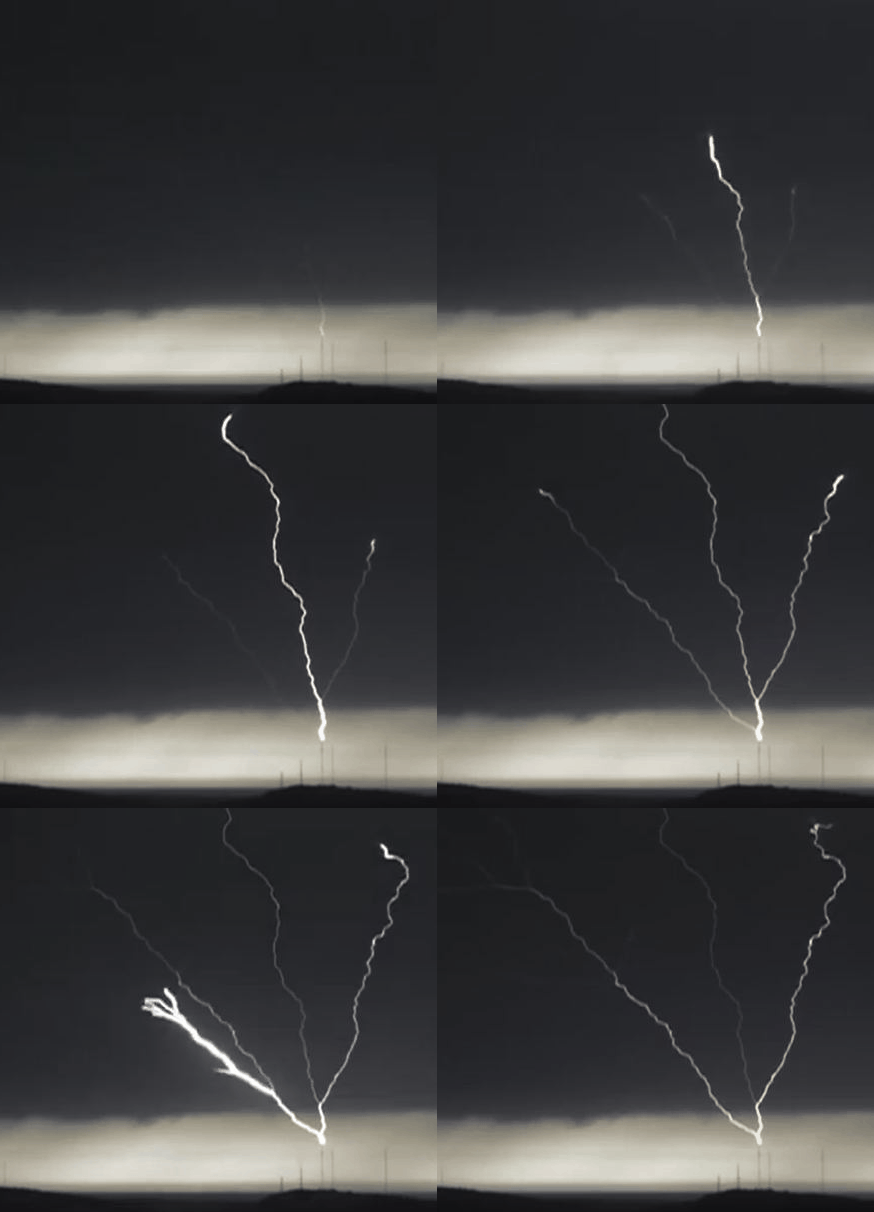
Recent studies of lightning showed that it doesn’t travel from one source to a destination but from both objects equally, with both sources aiming to neutralise the other. All of this happens so instantaneously though it’s only been able to be studied thanks to our high speed cameras.
Classification
There are actually three types of lightning:
- Cloud-to-Ground – Where the lightning forks between the cloud and the ground.
- Cloud-to-Cloud – Where the lightning passes between two different clouds
- Intracloud – Where the lightning passes inside of the cloud itself.
All of these types of lightning cause thunder, a loud crashing sound caused by the quick spark. A common method of determining the distance of a lightning storm is to count the time between the flash of lightning and clap of thunder. The flash travels at the speed of light, here on Earth that’s an almost instantaneous appearance, but thunder travels at the speed of sound, about 300 metres every second. For every second that passes, the lightning storm must be another 300 metres further away, this gives some helpful equivalencies:
- 3-4 seconds – One kilometre away
- 5-6 seconds – One mile away
- 6-7 seconds – Two kilometres away
- 10 seconds – Three kilometres away
- 10-11 seconds – Two miles away
And so on, however after this time, the volume of the thunder has most likely diminished too much to be heard very well.
How lightning forms
As mentioned, lightning is caused by the discharge of clouds, but how do the clouds build up this charge?
Storms are formed of clouds of water and dense atmospheric air. This intense collection of particles creates highly varying temperatures between different regions and this is often exacerbated by different winds and currents. Heat creates energy, this energy begins building up charge and the more the clouds are affronted by the wind the more energy is inputted into the cloud. Collisions between the cloud particles occur, the lighter particles are pushed upward by the wind but collide with heavier non-moving particles. The light particle, with its higher energy, easily loses an electron to the heavy particle, giving it a positive charge and the heavy particle a negative charge.
The positive particles keep moving upwards, whilst the negative charges sink to the bottom of the cloud. Eventually, the cloud becomes polarised meaning one part of it is incredibly positively charged and another incredibly negatively charged.
Particles don’t really like being charged, neither do they really like being neutral, but inputting energy of this scale forces the charge to build up such that now the particles desperately want to get rid of it all. However, it’s quite difficult for regions of high charge to transmit energy to regions of a similar charge as then overall no change would really occur. Instead, the lower negatively charged region looks for something that is of an equal but opposite charge to itself or something neutral (without charge), in Cloud-to-Ground lightning, this is the Earth.
In Cloud-to-Ground lighting, the highly charged cloud seeks the Earth as its target as the Earth has an effectively zero charge. A great potential difference is created between the two regions, but no energy can be transferred between the two until a pathway is formed. The cloud, desperate to lose its charge, begins emanating charged particles down towards the ground creating static electricity. This electricity causes small sparks to occur between objects and people’s hair to stand up on end. From here everything happens very quickly.
Despite the large amount of energy in the clouds, the lightning can only jump so far between particles. The charged particles it has been emanating eventually align in a sort of dot-to-dot between the cloud and the Earth, once they are all a good distance apart the lightning begins. From both ends, energy begins jumping between particles, with each jump the distance between the regions becomes smaller and the potential difference lowers. A wanted relief for the clouds.
The classical fork shape of lightning highlights the jumps between different charged particles as the electricity forms its path towards neutrality. Eventually, both ends of the lightning meet in the middle and the huge impact of the neutralisation is explosive creating a bright flash highlighting the pathway of energy, and a loud clap of thunder. In an instant the cloud and the Earth exchange energy until both are equally charged and the cycle begins anew.
Anytime, Anywhere
A common myth around lightning is that it can only occur in places that are warm but this is not true. Lightning storms can happen anywhere where a cold front meets a warm front, which in the current state of global warming can really be anywhere. Lightning storms tend to happen more frequently in hot climates as the hot surface level air travels up and collides with the cooler upper atmosphere, creating the perfect conditions for a storm.
Lightning can also happen simply due to density too. Snow clouds can form lightning if the snow begins rubbing against each other. Smoke clouds from fire often produce lightning due to the intense energies of the smoke particles. Mushroom clouds from atomic weapons are also known to produce lightning as the great energy and sudden wavefront causes atmospheric disturbances.
Humanity and the Storm
Lightning has occurred throughout all of Human history, with many different cultures having different myths and legends around the phenomenon.
- In Norse mythology, Thor is the god of Thunder, and the thunder and lightning was said to be from his hammer, Mjolnir, striking his foes.
- In Greek and Roman mythology, Zeus (or Jupiter) held the lightning bolt, and lightning was said to be Zeus himself striking down on humanity.
- Almost all pantheistic religions had or have their own version of a lightning god:
- Indra is the god of lightning for the Hindus
- Illapa was the god of lightning for the Incas
- Raijin is the god of lightning and thunder for the Shinto of Japan
What to do if you find yourself in a thunderstorm
Lightning is literally everywhere and it’s fascinating to find out how it all works, but a word of caution. Lightning, as with all electricity, is always trying to take the easiest path. If you stand between a cloud and the ground, you become the quickest way for all of that energy to get between the regions, and the lightning wont hesitate to take that shortcut.
If you find yourself in a lightning storm, try to stay indoors or at least try not to be the tallest thing around. Try to get to low ground but don’t stand below trees, if the lightning hits the tree you could be caught in the crossfire. If, however, you start to feel your hair stand on end or begin seeing small sparks, immediately crouch down and put your head between your knees, the smaller you are, the less likely the lightning will aim for you.
Stay safe out there,
kachow



Leave a comment