The short answer is yes, of course you can! The simple fact that we are all alive right now means that staying away from Black Holes is not only possible, but common. However, we here on Earth have the excellent starting condition of never being anywhere near a Black Hole, so it was never really an issue. That being said, the closer you get to a Black Hole, the more that answer of “yes” starts to get a little fuzzy, until the answer is definitely… No.
To start to understand why that is, first we need to learn all about two forces:
Pressure and Gravity.
Pressure
Pushing down on me, pushing down on you!
I’ve previously talked a little bit about pressure whilst I was at the peak of a mountain in the south of France, and you can read all about that here. For any new readers though, here’s the basics…
Pressure is a force that is acted on everything by everything else it is in contact with. The air around you has pressure, you have pressure, and the device you are reading this on? Yep, it has pressure too. Pressure is the force created by something trying to keep its shape, so anything that has shape has pressure.
The best visual of pressure are balloons. Before blowing up a balloon it has no air inside, so there’s nothing in it to create pressure. Once you start to blow air inside, particles of air start to fill the balloon. Each of these particles wants to keep its own shape despite all of the others it crashes into, so the particles start to increase the pressure inside the balloon.The trick with pressure is balance, if the pressure outside of something is equal to the pressure inside of something, everything stays as it is. In our balloon though, we’re creating pressure inside by adding more air. Now the pressure inside the balloon is much greater than the pressure outside of the balloon, the outside particles then get overwhelmed by the balloon’s pressure and the balloon starts to inflate!
If you were to stop blowing up the balloon and instead let some air out, the particles escape and the pressure inside decreases. The balloon now gets overwhelmed by the pressure outside and deflates until the pressure on both sides once again matches.
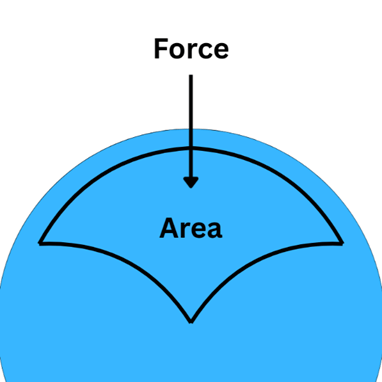
Pressure is defined as ‘The Force per Unit Area’, the weight pushing down on a surface essentially. Common units of pressure include mmHg, bar, and psi, but for the modern science world the most common unit is the Pascal or the Newton per square metre.
Pressure is closely linked to both volume and temperature. Increasing the pressure will make the object’s particles want to take up more volume, whilst decreasing the volume that something is already taking up will increase the pressure. Increasing pressure can also cause the temperature of an object to increase too, that’s going to come in helpful in the next section.
Gravity
It’s working!
Gravity is something that will be discussed in a lot more detail here at Cassiopeia, but for this lesson all that is needed to know is that gravity is a force that pulls all objects with mass towards each other. Similar to pressure, it’s a force that is acted on everything by everything else, but gravity doesn’t have to be in contact like pressure does.
Gravity is responsible for stars, huge balls of gas that are dotted all over the Universe. The closest star to us here on the Earth is our Sun which is about 150 million kilometres away and nearly 1.5 million kilometres in diameter! That’s more than 100 times the diameter of the Earth! Our Sun is massive, and it formed over five billion years ago thanks to gravity.
Stars are kept in what’s known as an equilibrium, similar to our balloon with its pressure on both sides. The huge amount of heat from all of the fusion in the centre of the star creates massive amounts of pressure! This pushes back against the gravity of the star which is constantly trying to pull the star closer together. The result is the star staying as it is for now, a big ball of fire that will stay in constant battle for billions of years.
Stars are classed by their masses, our Sun belongs to a grouping of stars simply classed as G-type; above this there are stars up to about 1.5 times the mass of the Sun that are classed as F-type; then there are stars up to 2x the mass of our Sun that are classed as A-type; after that is around 5x the mass that are classed as B-type; and finally at the top are stars that are more than 6x the mass of our Sun that are classed as O-type stars. These are the ones we need to mention today.
O-type stars are very rare, because it’s difficult to find enough material to even create a star that big. Then, even when one is created, it burns so big and bright that it loses all of its material in just a few short millennia. Thankfully, what happens next is where things get interesting.
Enjoying what you’re reading? Subscribe to Cassiopeia for more fascinating science lessons like this!
When stars start to die, they stop being able to produce as much heat in their cores. As mentioned, this heat was vital to creating the pressure that was fighting off gravity; now gravity starts to win.
With gravity in charge, the star begins to collapse inwards. Luckily, this pushing inwards creates more pressure and heat allowing the star to stay in action for another few million years, but even that starts to fail soon, and the gravity continues pulling further and further inward.
For O-type stars, there’s so much mass that gravity is easily able to overpower the interior pressure with ease. Gravity pulls inward and inward, the size of the star gets smaller and smaller, but the mass of the star isn’t able to go anywhere. The density of the star gets higher, but the volume only collapses further. Gravity pulls and pulls and pulls, crushing the star that used to be millions of kilometres in size down to something the size of the Earth.
This…is where I need to explain something else first.
Escape Velocity
The escape velocity of an object with gravity is the speed you need to go to get away from it. To escape from the Earth, you would need to be travelling at about 11 kilometres per second which is what rockets are able to do. To escape from Me, you would need to be travelling at about 0.1 millimetres per second; it would be less, but I’ve been eating a lot of ice cream lately. The escape velocity is dependent on the mass of the object; it does, however, come with an upper limit.
The speed of light is the fastest thing in the universe, it is, by definition the speed at which light travels. It is not possible to go faster than light without breaking something about reality, so for now let’s say that it is for definite the fastest you can go. Now, whilst this is just a fun lesson, I do need to use a couple equations to explain something very important. So here they are, this is the equation for the escape velocity:

In this equation, V is the escape velocity that I described earlier, G is a useful constant that is used everywhere with gravity, M is the mass of the object usually in kilograms, and r is how far away from the object you start from which is usually measured in metres. Right back at the beginning of this lesson I mentioned how we are safe because the Earth is nowhere near a Black Hole, and this equation is why; our distance from any Black Hole is so far, that our escape velocity is even tinier, and we can easily get away.
However, what if that escape velocity was the fastest that anything could go. What if to escape from an object you had to be going the speed of light and if you couldn’t go that fast? A simple rearranging of our equation gives us the answer…
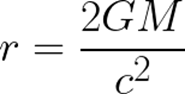
This distance is known as the Event Horizon, the point of no return.
The Event Horizon
Abandon All Hope, Ye Who Enter Here
Like with the escape velocity, everything that has mass has an event horizon; for most objects though, it’s not an issue. That’s because usually the objects own surface is greater than that distance. The Earth’s event horizon is about 8 millimetres, fortunately its diameter is about 12,000 km so no one will ever get that close. My Event Horizon is about 1 octillionth of a metre (again really got to cut back on the ice cream), but I also have skin and bones and stuff in the way, so I don’t pose any problems for anyone. That being said though, what about our collapsing star?
As mentioned, despite the ongoing collapse the mass of our star is staying the same, but the gravity is pulling it smaller and smaller. Eventually, the surface of the star falls below the star’s own Event Horizon, now not even light can escape from it, and the star has changed into a Black Hole.
The most well known Black Hole is one known as Sagittarius A*. It forms the centre point of our galaxy, the Milky Way, meaning it is so massive it is able to pull things like our sun towards it from over 200 quadrillion kilometres away (200,000,000,000,000,000 kilometres). The Black Hole has a mass of over 4 million Suns, meaning it’s Event Horizon is Thirteen BILLION kilometres, compared to it’s estimated surface radius of only 50 million kilometres. It is an incredibly efficient Black Hole, and in 2017, astronomers managed to take the first picture of it.
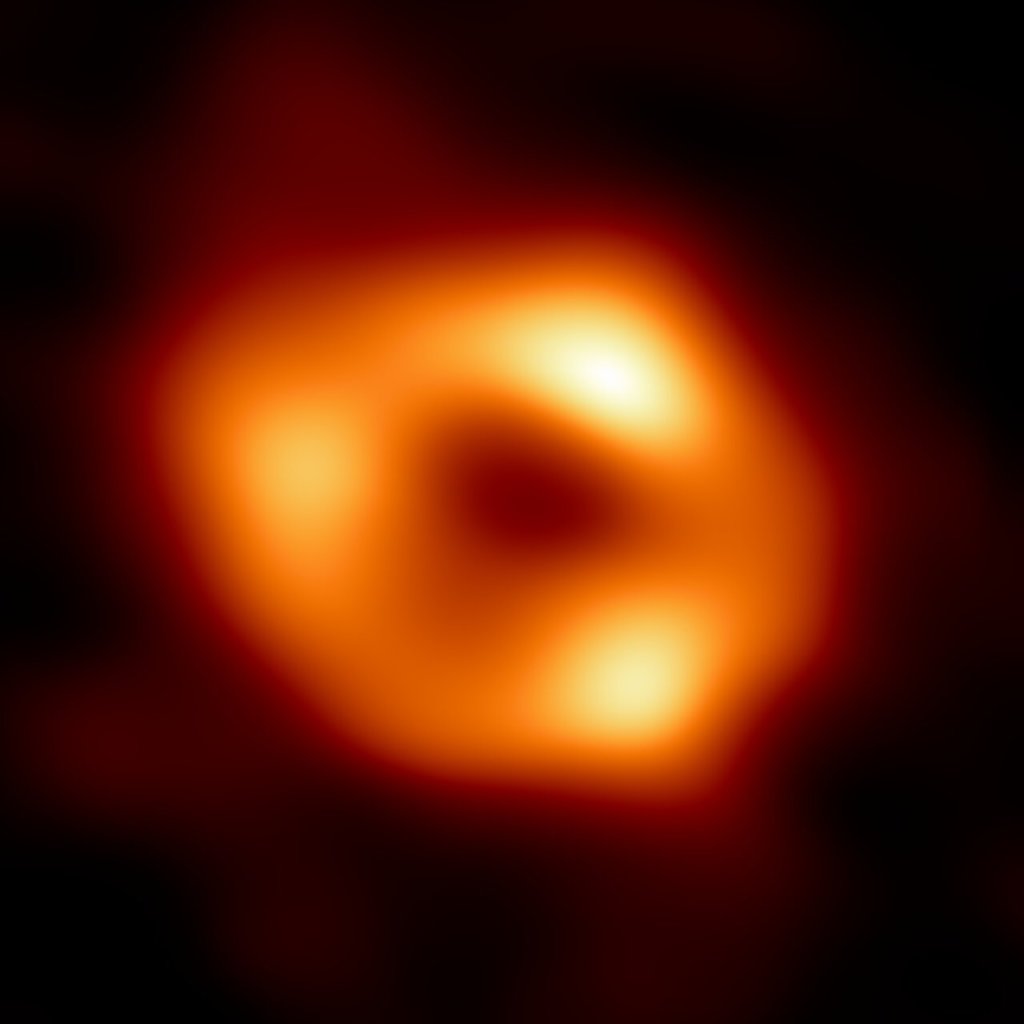
(https://eventhorizontelescope.org/)
Black Holes are quite aptly named. If you were to observe one, it would appear completely black. Any light it emits can’t escape from it, any light behind it can’t pass through as it instead gets pulled in, they simply look like gaps in the Universe. The question of course then has to be: “What would happen if you fell into one?”
We’ll ignore any time problems for now because that’s a whole can of worms I’ll get into some other time, let’s say you’re just regularly falling into a Black Hole. What would that be like? I think I can put my writing skills to good use and give you a fairly apt description:
As you fly towards the Black Hole, everything begins to bend around you. Distant galaxies start to distort and even your own hands look to be hundreds of metres away as the light becomes dragged away. The only constant object is the soulless blackness before you. You pass the Event Horizon, no going back now, the empty blackness of the void in front of you begins to surround you on every side as you grow colder and colder; the heat from the Universe has left you. Behind you, the last light of the Universe starts to shrink as the waves struggle to reach you around the Black Holes impressive gravity. Darkness envelopes.
Suddenly, you feel it. A small tugging on your legs that are closer to the Black Hole, but strangely no such force on your head. As time goes on that tugging starts to pull, your own body starts to stretch. You are so close to the Black Hole, that the difference in gravity between your legs and your head is too great, the pressure is so great that your own body starts to be pulled apart.
The forces in your cells are overwhelmed, your molecules become disentangled, and your very atoms become inhospitable. Your body from your legs to your head becomes a swirling, twisting, lengthening tube; like spaghetti down a never-ending plughole. Finally, as you feel your own body come apart, you look back out at the Universe, and see the last pinprick of light fade, as the empty blackness becomes your only remaining reality and you… become…
…nothing.
…
See, wasn’t that fun! Now you know what it would feel like to fall into a Black Hole. Don’t worry though, there aren’t any Black Holes anywhere near us, and the chances of any human going anywhere near such a thing is impossibly tiny…
…but never zero.
So, to answer the question of this lesson, “Can you Escape a Black Hole?” Yes, so long as you stay above the event horizon. Nevertheless, if somehow you do go happen to go past an event horizon, make sure you hold on to your legs!
Now, where did I put that ice cream?



Leave a comment