
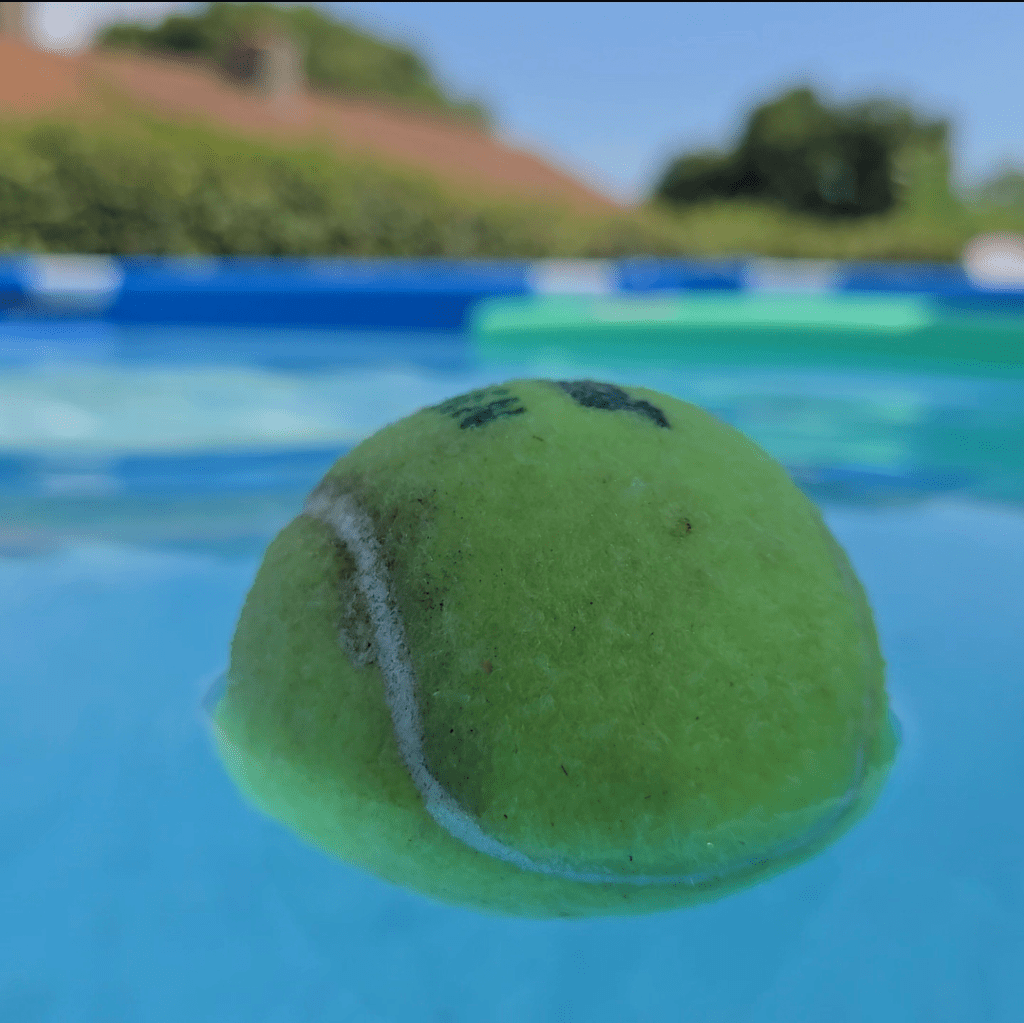
It’s still impossibly hot here in southern France. Temperatures the other day got up to 40 degrees, and it doesn’t tend to cool down much in the evenings either. As such, I’m in desperate need of a method of cooling down, and as it happens, I have one!
As part of another adventure I’ve got in the works, I happened to be staying somewhere that has a pool! This glorious, humongous bowl of water is exactly what I need to cool myself off in, so as soon as I could I put my swimming costume on and dipped myself in.
Now that I was less hot, I wanted to just relax, so grabbed myself a lilo and laid back upon the waves.
Or rather I would have relaxed, if my brain didn’t start wizzing around my head trying to understand just how I was able to do this. It’s time for Sunday School folks. You know it, you love it, today we’re learning of the ancient phenomena of buoyancy.
The Basics
Buoyancy describes the ability of an object to float within a fluid (either a liquid or a gas). It’s all to do with the densities of everything involved, the general rule is that if something is more dense (weighs more for the same volume) it will sink and if that something is less dense it will float.
Let’s demonstrate, here I have a tennis ball:
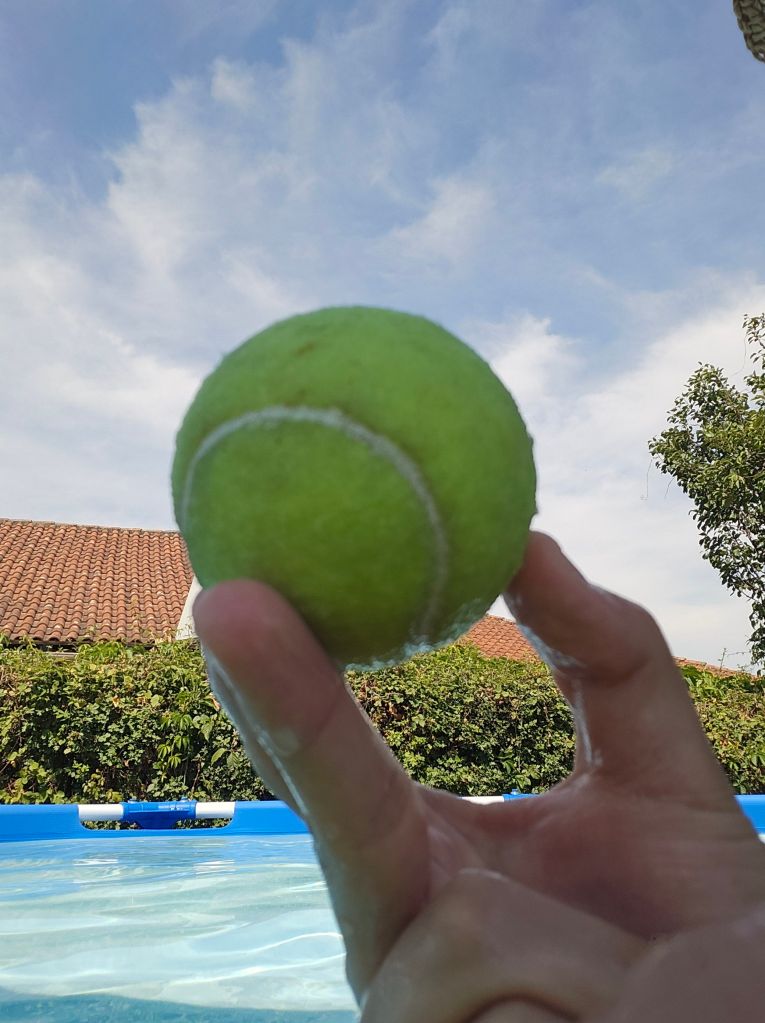
It’s made out of rubber, which has a density of 1.1 grams per cubic centimetre (g/cm3) so by our rule above it should sink in the water, which has a density of just 1 g/cm3! And yet…
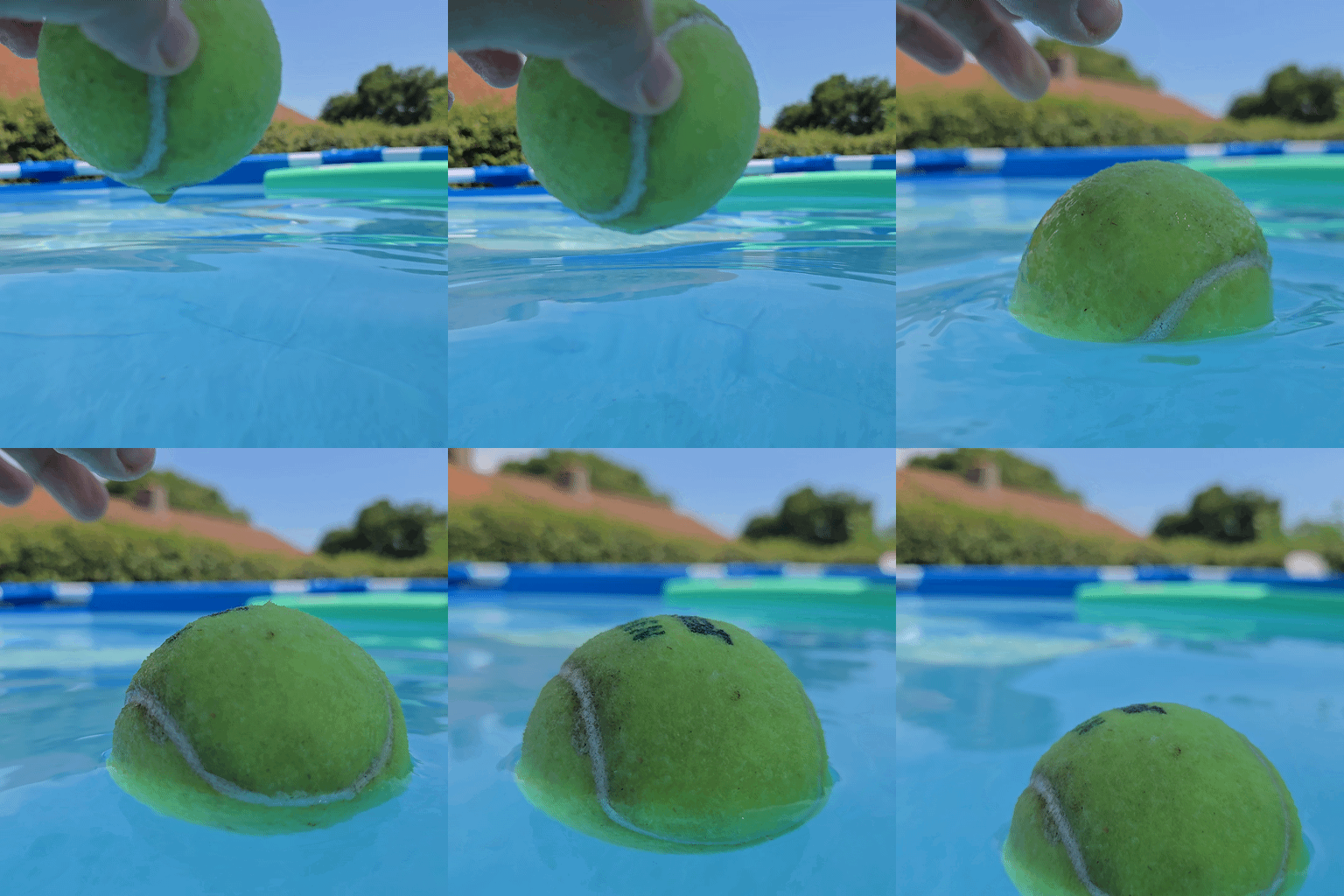
How does that work? Well, because the ball is full of air! Air has a density of 0.001 g/cm3, much much less than water, so we humans have figured out that if you fill something with air it will float! Just how much it floats now depends on the Principle of Buoyancy, also know as Archimedes’ Principle.
Ancient Knowledge
Any object, wholly or partially immersed in a fluid, is buoyed up by a force equal to the weight of the fluid displaced by the object.
To displace something means to move it out of the way. My tennis ball floats, but part of it hangs under the surface, as you can see here:

The force acting on the ball from the water comes from gravity. The water wants to move down but the ball is in the way, so the water tries to push the ball back up creating a force!

This force goes up, but gravity is still pulling the ball down too. Balance these forces, and you get a constant volume that the ball is submerged by, and thus, the ball floats!
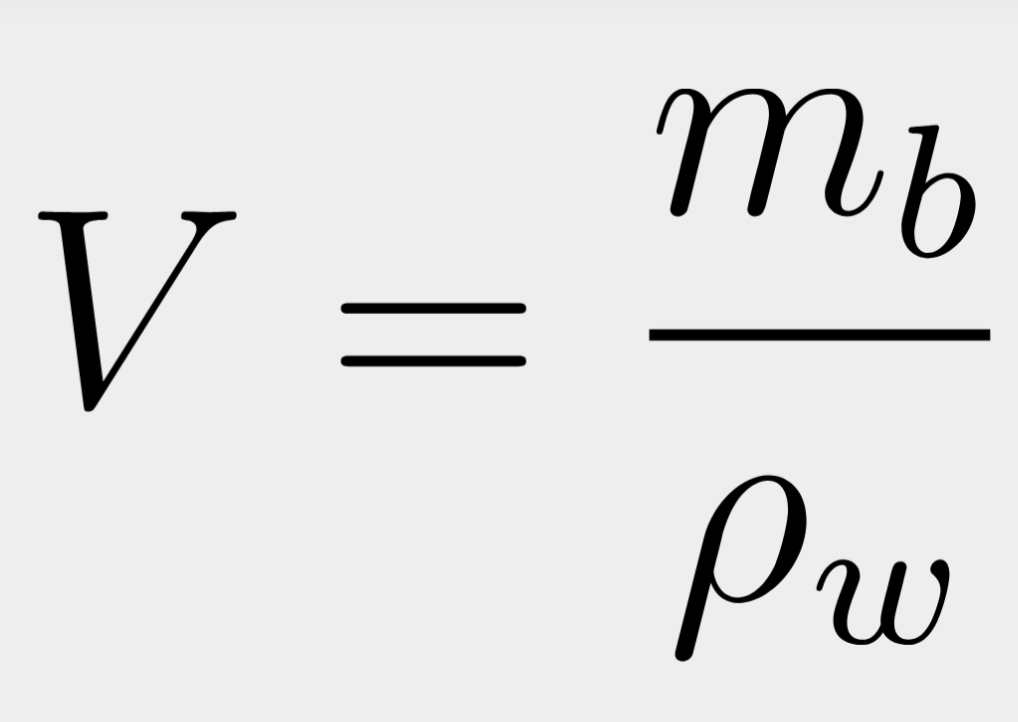
The interesting part is, gravity isn’t included in this equation. So, no matter which planet on the solar system you’re on, the ball will float to the same level!
There’s one last thing to show with buoyancy.
You’ll float too
Humans, on average, according to my research, have a density of about 1.05 g/cm3, just more than water. We are mostly made out of the stuff after all!
However, humans also have an amazing ability called breathing! If I breathe in enough air, lowering my density, I should float.
I set about practising. It was difficult to get myself horizontal enough where I could show myself breathing in and out. In fact, I almost drowned myself a couple of times by accidentally breathing in after my head dipped below the surface. Whoops!
Here is the result of my best attempt where you can see my abdomen rising and falling as I breathe in and out!

I am buoyant! I have used physics to not drown.
So there you have it, buoyancy. It’s been used by humans for thousands of years to build things like boats so that we can successfully travel the seas and explore our planet! There are just three key points to remember:
- Too heavy and it will sink
- Too light and it won’t break the surface
- Just heavy enough and it will sit perfectly just below the surface, floating!
The lessons over now, you may continue your restful Sunday. Try not to get a sunburn though!
Cassie






Leave a comment